The Workflow
Seven steps. One afternoon.
The full pipeline at a glance — from raw documents to a compliant first-draft proposal, with a human decision at every step.
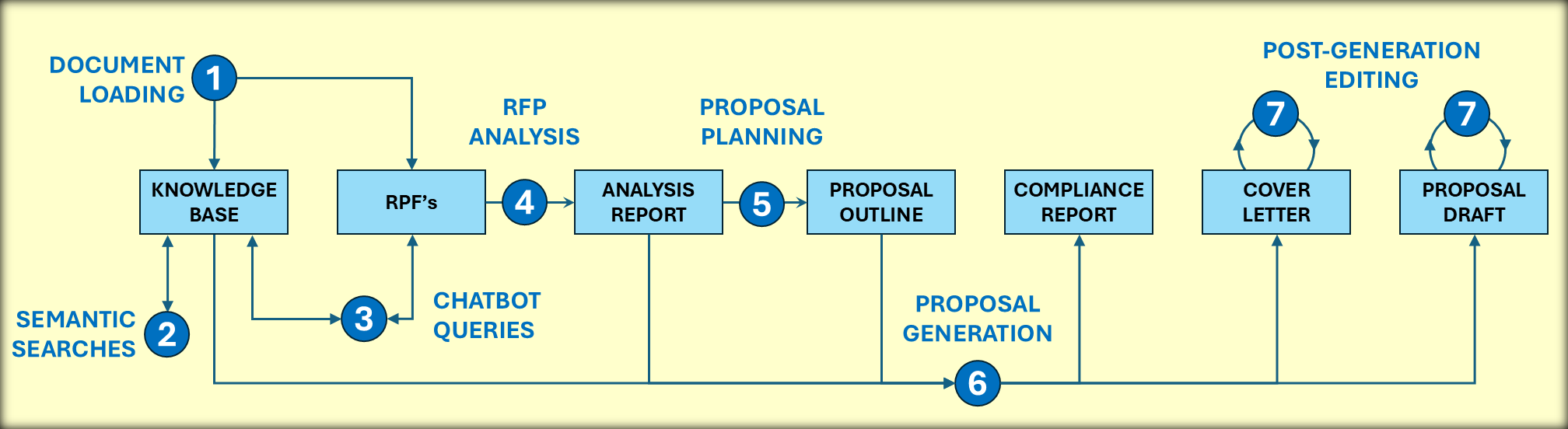
Ingest your knowledge base
Point ProjEx at your existing corpus — past proposals, personnel bios, case studies, methodologies, safety plans. Documents are chunked and embedded locally with a small on-device model.
Why it matters: nothing leaves your machine. No SaaS ingest, no third-party embedding endpoint, no data-processing agreement to negotiate.
Chat with your KB to curate it
Ask questions in plain English against your own KB before you ever look at an RFP. Confirm what's there, what's missing, what needs an update.
Why it matters: the quality of every proposal downstream is capped by the KB's quality. This step is where SMEs shape that ceiling.
◉ Human decisionSemantic + hybrid retrieval
Vector search over embeddings, blended with BM25 keyword scoring, gets the right chunks to the LLM at the right moment. Zero manual prompt-stuffing.
Why it matters: your existing evidence — bios, case studies, past section text — flows into every generated section without a human bookkeeper.
Read the RFP end-to-end
A four-pass extractor reads every page (text + tables + figures) and produces a structured Analysis grid: requirements, personnel constraints, schedule milestones, evaluation criteria, submission rules.
Why it matters: the "did we miss something?" question is settled at extract time, not the night before submission. Every requirement is tagged and searchable.
◉ Reviewable + editableDraft a compliance-bound outline
The Outline Creator proposes sections tied to specific requirements from the Analysis. A Python validator refuses any outline that leaves a mandatory requirement unbound.
Why it matters: the outline is auditable before a single sentence of body text gets written. Fix it in five minutes, not five hours.
◉ Approves outlineGenerate the first draft
Per-section Writer runs against KB retrieval + Analysis context. In parallel: Cover Letter (iterative refinement), Draft Proposal body, and a per-requirement Compliance Report scoring the finished draft against the RFP.
Why it matters: a coordinated first pass — not a wall of AI text you have to reassemble. Compliance scoring flags gaps the same run.
SME polish, not blank-page
AI Assist lets your subject-matter experts refine any section with a targeted instruction: tighten the safety language, add a specific case reference, tone-match the client. Every edit is versioned.
Why it matters: your SMEs are reviewing and refining, not staring at an empty document at midnight. Every version is diff-able.
◉ SME final pass